
I created a benchmark in C++ for testing and comparing TeaScript and its competitor ChaiScript by computing the Fibonacci number of 25 recursively. As a reference I did the same also in C++. The complete source code of the benchmark is available below.
The result is pretty amazing, since with the used pre-release 0.8.0 of TeaScript I did not profile and optimize yet. This is a task for a future release. The latest release of TeaScript is available in the download section.
(UPDATE 2023-01-17): I created a Github Repository for this and all future benchmarks comparing script languages in and for C++.
(UPDATE 2024-03-08): I created a new benchmark for filling a 32 bit Full HD (or UHD) image buffer pixel by pixel. Read the results here: New Benchmark.
Here is the benchmark result: Computing time of fibonacci( 25 ) measured in seconds. Shorter is better/faster, longer is slower.
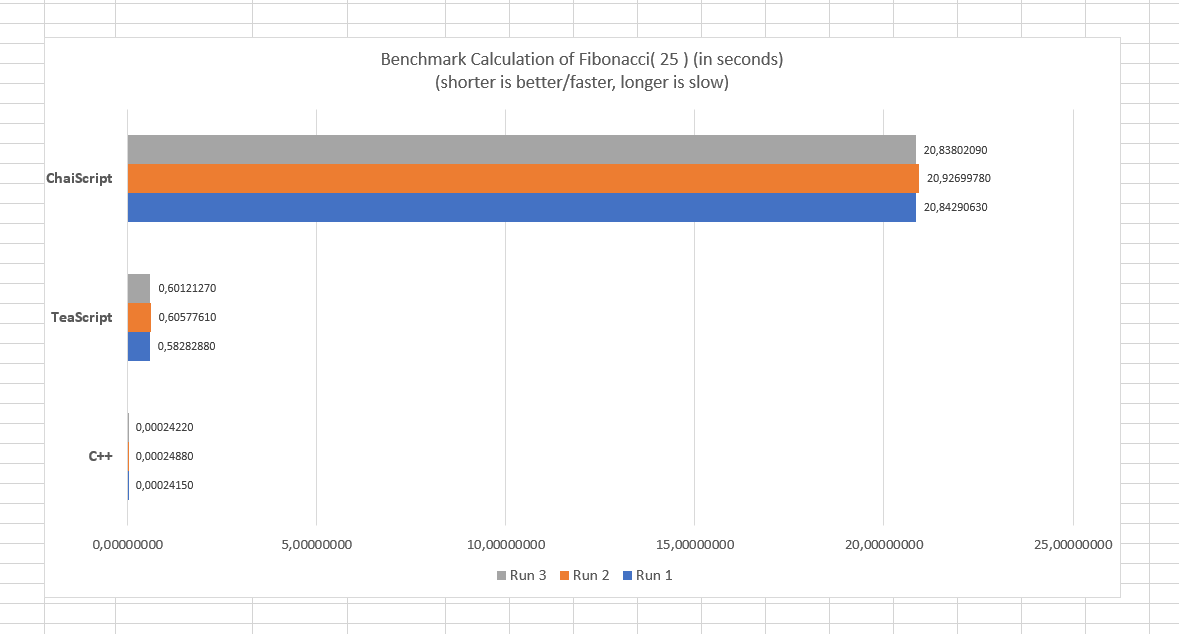 Diagram of benchmark result computing Fibonacci.
Some technical information about the environment: OS: Windows 10 21H2 (64bit) CPU: Intel Core i7-11700 RAM: 32 GB Compiler/Build: Visual Studio 2022 Community (17.4.3), Release/x64 (AVX2), C++20.
Some notes to Python and Lua: Python as well as Lua are actually not in competition with TeaScript from the performance point of view since TeaScript and ChaiScript are real script languages (and header only C++ Libraries), but Python and Lua are compiling the source to a bytecode and executing it in a virtual stack machine (Python) or in an even a more complex virtual machine (Lua).
This may change with a later version of TeaScript.
Here is the C++ source code of the benchmark:
/*
 * SPDX-FileCopyrightText: Copyright (C) 2023 Florian Thake, <contact |the-at-symbol| tea-age.solutions>.
 * SPDX-License-Identifier: MIT
 */


#include <cstdlib> // EXIT_SUCCESS
#include <cstdio>
#include <iostream>
#include <chrono>

#include <teascript/Parser.hpp>
#include <teascript/CoreLibrary.hpp>

#include <chaiscript/chaiscript.hpp>

// recursive fibonacci function in TeaScript
constexpr char tea_code[] = R"_SCRIPT_(
func fib( x ) {
   if( x == 1 or x == 0 ) {
      x
   } else {
      fib( x - 1 ) + fib( x - 2 )
   }
}

fib(25)
)_SCRIPT_";

// recursive fibonacci function in ChaiScript
constexpr char chai_code[] = R"_SCRIPT_(
def fib( x )
{
    if( x == 0 || x == 1 ) {
        return x;
    } else {
        return fib( x - 1 ) + fib( x - 2 );
    }
}

fib(25);
)_SCRIPT_";

auto Now()
{
    return std::chrono::steady_clock::now();
}

double CalcTimeInSecs( auto s, auto e )
{
    std::chrono::duration<double> const  timesecs = e - s;
    return timesecs.count();
}

double exec_tea()
{
    teascript::Context c;
    teascript::CoreLibrary().Bootstrap( c );
    teascript::Parser  p;
    auto ast = p.Parse( tea_code );
    try {
        auto start  = Now();
        auto teares = ast->Eval( c );
        auto end    = Now();

        std::cout << "value: " << teares.GetAsLongLong() << std::endl;

        return CalcTimeInSecs( start, end );

    } catch( teascript::exception::runtime_error const &ex ) {
        teascript::util::pretty_print( ex );
    } catch( std::exception const &ex ) {
        puts( ex.what() );
    }

    return -1.0;
}

double exec_chai()
{
    chaiscript::ChaiScript chai;
    auto ast = chai.parse( chai_code );
    try {
        auto start = Now();
        auto chres = chai.eval( *ast );
        auto end   = Now();

        std::cout << "value: " << chaiscript::boxed_cast<int>(chres) << std::endl;

        return CalcTimeInSecs( start, end );

    } catch( chaiscript::Boxed_Value const &bv ) {
        puts( chaiscript::boxed_cast<chaiscript::exception::eval_error const &>(bv).what() );
    } catch( std::exception const &ex ) {
        puts( ex.what() );
    }

    return -1.0;
}

// recursive fibonacci function in C++
long long fib( long long x )
{
    if( x == 0 || x == 1 ) {
        return x;
    } else {
        return fib( x - 1 ) + fib( x - 2 );
    }
}

double exec_cpp()
{
    try {
        auto start = Now();
        auto res   = fib( 25 );
        auto end   = Now();

        std::cout << "value: " << res << std::endl;

        return CalcTimeInSecs( start, end );

    } catch( std::exception const &ex ) {
        puts( ex.what() );
    }

    return -1.0;
}

int main()
{
    std::cout << std::fixed;
    std::cout << std::setprecision( 8 );

    std::cout << "Benchmarking TeaScript and ChaiScript in calculating Fibonacci of 25...\n";
    std::cout << "... and C++ as a reference ... \n";

    std::cout << "\nStart Test C++" << std::endl;
    for( int i = 3; i != 0; --i ) {
        auto secs = exec_cpp();
        std::cout << "Calculation took: " << secs << " seconds." << std::endl;
    }

    std::cout << "\nStart Test TeaScript" << std::endl;
    for( int i = 3; i != 0; --i ) {
        auto secs = exec_tea();
        std::cout << "Calculation took: " << secs << " seconds." << std::endl;
    }

    std::cout << "\nStart Test ChaiScript" << std::endl;
    for( int i = 3; i != 0; --i ) {
        auto secs = exec_chai();
        std::cout << "Calculation took: " << secs << " seconds." << std::endl;
    }

    puts( "\n\nTest end." );

    return EXIT_SUCCESS;
}
... and this is the screenshot from the run:
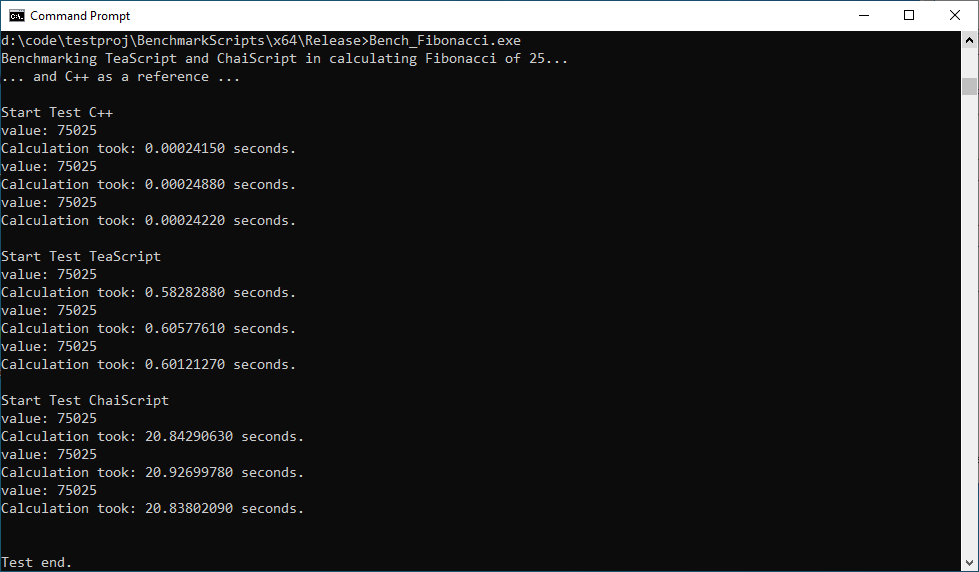 Screenshot of the benchmark run.
BTW: The download package of TeaScript contains a script (beside others) for calculating Fibonacci Numbers inclusive time measurement.